For decades, the scientific community has held a narrow view of RNA's capabilities, believing it could only create simple, small structures. However, groundbreaking findings suggest that naturally occurring RNA can assemble into significantly larger and intricate forms, including filaments and cages. This revelation raises questions about the role these structures might have played at the onset of life.
Understanding the RNA World Hypothesis
The RNA world hypothesis posits that RNA-based life forms preceded the modern DNA and protein-based organisms we see today. In contemporary biology, RNA serves primarily as a messenger or functional molecule rather than the main genetic material. Early life forms leveraged RNA for both genetic storage and catalyzing biochemical reactions.
Reframing RNA's Structural Potential
Traditionally, the belief was that only proteins could create large, complex structures, primarily due to the diversity of amino acids they utilize. Proteins are made up of 20 distinct subunits, allowing for a wide array of configurations, whereas RNA features just four similar nucleotide subunits. New research challenges this assumption, showing that RNA can also form complex configurations, albeit utilizing fewer types of building blocks.
This shift in understanding comes from a recent study published on the preprint server bioRxiv. Researchers demonstrated that certain RNA sequences can engage in self-assembly through "kissing stem loops,” a mechanism where RNA strands fold back on themselves to create loops that can bond with each other, leading to larger molecular complexes.
Experimental Findings
The research team, led by Lin Huang from Sun Yat-Sen University, focused on RNA sequences from bacteriophages — viruses that infect bacteria. They synthesized several of these RNA types in the lab, facilitating their self-assembly and probing their resultant structures using cryo-electron microscopy. Their experiments revealed that some RNA molecules formed extensive filamentous structures akin to the cytoskeleton of cells, which is essential for maintaining cell shape and facilitating movement.
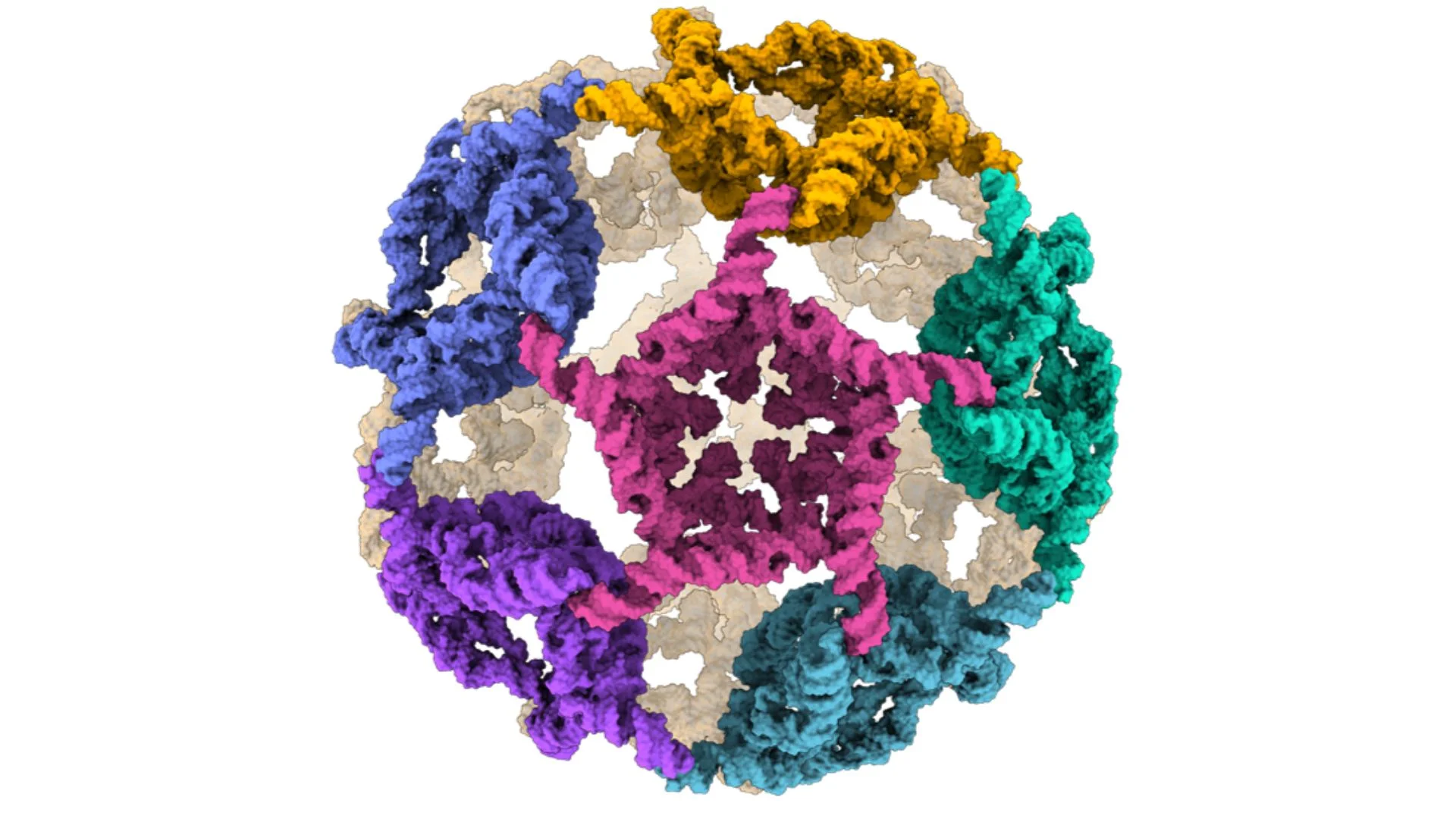
In addition to filaments, the researchers observed RNA forming cage-like structures, some resembling icosahedrons, which are three-dimensional shapes comprised of twenty equilateral triangles. Notably, this shape is characteristic of many protein-based viral capsids, raising intriguing possibilities about whether RNA could have served a similar purpose in early life by packaging genetic material.
Implications for Understanding Life's Origins
Despite these findings demonstrating the potential for RNA to construct complex structures, this does not confirm that such formations were present in the primordial scenarios of the early Earth. As evolutionary biologist Anna Medvegy from Eötvös Loránd University pointed out, if these structures are indeed products of conditions similar to those that existed during life's inception—such as extreme heat and low pH—they could offer critical insights into RNA's role in early biological systems.
Interestingly, the RNA molecules utilized in this study are relatively short, with strands no longer than 200 nucleotides. This is significant because longer RNA strands are typically more prone to degradation, so the ability of short RNA to form stable, complex structures strengthens the argument that RNA was a key player in the early evolutionary landscape.
Future Research Directions
First, researchers need to verify whether these structures can assemble within bacterial cells, influenced by the internal environment, including potential interactions with proteins. Such findings could be pivotal in understanding both the evolution of RNA and its relevance in contemporary molecular biology.
Beyond the fundamental implications for the origins of life, RNA’s newfound capacity for forming complex structures opens avenues for biotechnological applications. Huang envisions a future where RNA, much like DNA origami, could be employed in drug delivery systems, highlighting the potential merging of biochemical research with practical medical applications.


