A fish kill exposes a persistent carp problem
The removal of about 40 tonnes of dead carp from Barongarook Creek has exposed the scale of the challenge facing authorities around Lake Colac: a fish kill can be cleared, but the carp population remains. The mass death occurred during breeding season, when carp moved from the lake into the creek and low oxygen levels left them dying in large numbers. The cleanup can make the creek more tolerable for nearby residents, but it doesn't answer the question of how to limit the next influx.
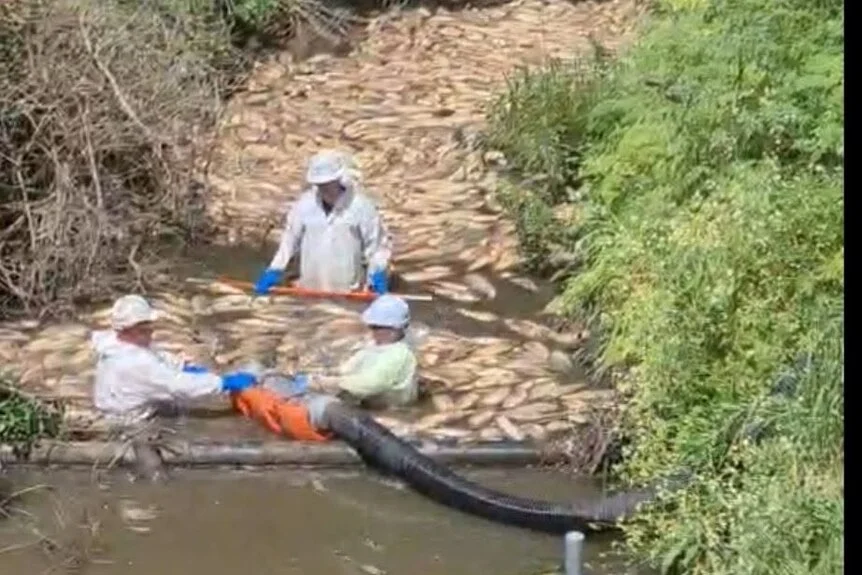
Council staff were pictured clearing the dead fish by hand. (Supplied: Roland J Kettle)
Cleanup addresses the immediate impact
Colac Otway Shire Council organised the cleanup after residents raised concerns about the smell of rotting fish. Crews removed carcasses by hand, while a truck equipped with suction gear was brought in to clear fish and limit the odour. Council infrastructure and environment general manager Doug McNeill said the equipment had been effective, though some disturbance was likely to continue while work proceeded. That work responds to an urgent local problem: decomposing fish affect how the creek smells and feels to people living nearby, even as the cause of the deaths remains a wider waterway concern.
The council described the deaths as a naturally occurring event linked to low water flows and insufficient oxygen. In a creek with limited flow, conditions can deteriorate when large numbers of fish gather in one place; here, the carp had moved out of the lake to breed. The scale is unusual: McNeill said the area had not experienced a fish kill of comparable size since about 2009. At the time, some believed the carp had all died, but they later rebounded after breeding in the mud. That episode is a warning against treating a dramatic die-off as population control.
The carp have been established in Lake Colac and its creeks for decades. Resident Pam Cuthbertson said the waterways had become increasingly overrun since the species was introduced in the 1960s, and described the current concentration as unprecedented in her experience. Her account gives the scale a local frame: the problem isn't just the number of fish found dead, but the dense schools residents have seen in the waterways over time. This is more significant than it looks; the cleanup reveals how quickly a seasonal movement can turn into a public nuisance and an ecological concern.
"Thousands and thousands all jammed up against each other. You couldn't get a twig between them,"
Cuthbertson called the event a catastrophe and an environmental disaster, and voiced concern about the lake and surrounding waterways. Her description reflects the anxiety of someone watching a familiar waterway change, though the available information doesn't establish what lasting ecological effects this particular kill will have. For residents, the immediate evidence is hard to miss: dead fish, odour and a large cleanup effort.

Pam Cuthbertson is concerned for the health of Lake Colac and its surrounding waterways. (ABC News: Jean Bell)
Long-term control remains the hard part
McNeill said the shire had been working with the state government and Corangamite Catchment Management on the broader problem. However, neither the Victorian Environment Protection Authority nor the Corangamite Catchment Management Authority had an active role in this particular incident: the EPA said it would not investigate because the deaths did not involve waste or pollution. That distinction helps explain the agencies' response, but it leaves the council managing the visible consequences while broader control efforts sit elsewhere.
Taylor Hunt, recreational fishing manager at the Victorian Fisheries Authority, said officials were examining ways to reduce carp numbers. He cautioned that eradication is difficult, pointing to Tasmania’s effort to functionally remove carp from two waterways, which took almost 30 years and more than $15 million. The example sets expectations: removing a population from a waterway can demand sustained work, and a single intervention may not hold if fish can continue breeding or moving between connected areas.
Options under consideration include screens to stop carp entering the creek to spawn, and large-scale catches when the lake naturally dries. Screens would target the movement linked to this incident, while catches would take advantage of changing water conditions. Each approach would need to work within the creek and lake's natural patterns. A carp virus could become another tool, but it is still being tested by CSIRO. Hunt said any use would depend on the virus proving safe and practical. For now, that remains a possibility under assessment, not an available fix.
What success could look like
The immediate task is to remove the remaining carcasses and manage the odour. The longer-term measure of success will be whether authorities can keep carp numbers low enough to reduce their effect on the waterways, even if eradication remains out of reach. If you're working in this space, the central challenge is to connect short-term response with measures that address breeding and movement; otherwise, another cleanup may follow the same pattern. And the part most people overlook is that a mass death can reduce the visible number of fish for a time without resolving the conditions that let the population rebound. A difficult, sustained effort.