Recent observations by the James Webb Space Telescope (JWST) have shed light on the enigmatic phenomenon of 'little red dots' (LRDs), which have puzzled astronomers for years. These brilliant yet compact celestial objects emerged around 600 million years post-Big Bang, during a time when the universe was still in its infancy, having reached only about 10% of its current age. After about a billion years, these LRDs began to fade from view.
Understanding Little Red Dots
LRDs may seem like a niche interest within astrophysics, but they represent a significant piece of the cosmic puzzle. These objects don't just twinkle; they're remnants of a bygone era, encapsulating clues about the early universe's structure and phenomena. Scholars often analyze their formation in terms of how massive star systems evolve and how early galaxies may have formed. The mechanisms at play during this period could inform us about the conditions necessary for creating the universe as we know it today.
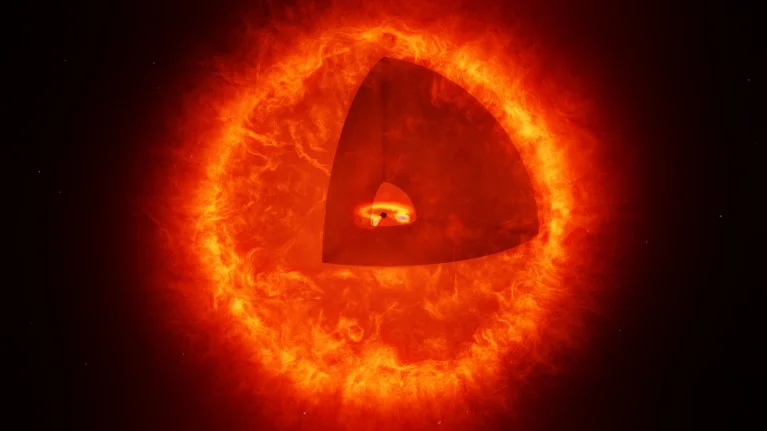
In a pivotal study published in The Astrophysical Journal Letters, researchers put forth a compelling hypothesis regarding LRD formation. They suggest these objects may originate from previously undiscovered celestial companions, which emit intense ultraviolet (UV) radiation. This UV light could trigger the collapse of surrounding gas clouds into extraordinarily dense and unique formations, perhaps akin to "black hole stars." If true, this theory reshapes our understanding of star formation under extreme conditions.
The Significance of Companions
First author of the study, Josephine Baggen, an astronomer at Yale University, remarked on the complex emissions around these LRDs. She noted, "The most surprising aspect… is that these little red dots are not just 'red dots,' but there is a more complex emission nearby." This commentary highlights an essential aspect of astronomical research: appearances can be deceiving. The study examined a sample of 83 LRDs, with the JWST's capabilities allowing them to analyze those in ultradeep surveys. Intriguingly, 36 of the 83—particularly the brightest—housed at least one companion emitting blue-hued UV light. If you're working in this space, you'll recognize this finding as a potential turning point for understanding the composition of distant cosmic structures.

The companions’ masses span from hundreds of millions to billions of solar masses. They may represent star clusters or small early galaxies, showing us the diversity of structures in the early universe. The intense UV radiation from these nearby companions inhibits the fragmentation of cold molecular gas clouds, a significant aspect typically conducive to star formation. Thus, rather than following the traditional star formation pathways, the exposure to UV light could propel gas clouds directly into forming supermassive stars or even black holes. This approach could circumvent the usual supernova explosion associated with the lifecycle of stars and raises questions about the dynamics of cosmic evolution.
This research offers explanations for the brightness of LRDs in red light and UV wavelengths, with a notable dip between. The light absorbed by hydrogen in the surrounding gas accounts for this gap. Essentially, the red light originates from the LRD itself, while the UV light is emitted by its companion. Researchers speculate that all LRDs might have such companions, although they could currently be too close together to be detected separately. Moreover, given the immense distances involved, many others could be further apart than accounted for in this study, which could warrant deeper follow-up observations—and this is the part most people overlook. The potential for hidden cosmic structures laying just beyond reach is tantalizing.
Galactic Implications
Fascinatingly, this research might clarify two significant puzzles concerning the early universe. Black holes emerging from these interactions could range from 100,000 to a million solar masses, potentially acting as "seeds" for the emergence of supermassive black holes very early in cosmic history. This possibility directly ties to questions around how the massive black holes we observe in the centers of galaxies formed so early in the universe's existence.
Furthermore, since LRDs could merge with their UV-emitting counterparts, this mechanism might help explain how the colossal galaxies we see today came into being. The events happening in those primordial times could mirror some of the processes we see in present-day galaxy formation. Baggen speculated, "We do think that this might be the birth of the supermassive black holes around these UV companions, born 'outside the galaxy,' [which] will eventually merge." However, speculation isn't certainty; many variables can influence these formations. The exact fate of the Milky Way during its formative years remains uncertain, but such scenarios are plausible given our current understanding. The evolution of LRDs and their ultimate fate continue to be hotly debated among astronomers.
Future Outlook
The implications of these findings could reshape our understanding of cosmic evolution. As observational technology improves, particularly with instruments like JWST, our ability to investigate these distant phenomena will only enhance. If researchers can track more LRDs and establish clearer relationships between them and their companions, they might unveil a far richer picture of the universe's early history. This goes beyond academic inquiry; understanding the origins of black holes and galaxies could influence theoretical models concerning cosmic structure formation.
However, here’s the thing: with every breakthrough, there are new questions to grapple with. What role do dark matter and dark energy play in this intricate dance of formation? How do these findings integrate into wider cosmological theories? As we venture further into the cosmos, we're bound to uncover complexities that challenge our understanding and push the boundaries of known astrophysical principles.


