A year after Typhoon Tino tore through Cebu, the anniversary brought a hard question into focus: what has changed for people who still face flooding, insecure housing and uncertainty about whether flood-control measures are working? Residents and civic groups raised those concerns in the Padayon Cebu chat room on Muni in the Rappler app, as communities marked the disaster’s first anniversary on Wednesday, November 4.
The discussion, titled “Isang taon matapos ang Tino, kamusta na ang Cebu?” (How is Cebu a year after Typhoon Tino?), paired personal accounts with scrutiny of recovery efforts. Its central message was clear: remembering the storm matters, but families still need safer places to live and evidence that promised flood-management work is being carried out.
Flood risk continues after the storm
Jerome Valdez, a Cebu-based Mover, shared the experience of Alma Quingco, 46, from Barangay Maslog in Danao City. Quingco was working at the University of the Philippines Cebu when Tino struck. By the time she returned home, floodwater had cut off access to the house and swept away many of the family’s belongings.
The damage did not end when the water receded. Valdez said Quingco continues to feel fear and trauma connected to the disaster, especially when she recalls how quickly flood levels rose. Her account reflects a less visible part of recovery: the shock of a fast-moving flood can remain long after a household has begun rebuilding.
In Tambisan, the problem is also recurring exposure. Residents described serious flooding even during ordinary rainfall, while some families whose homes were destroyed still lack safe, permanent relocation. Violy Musngi of La Paloma Village recalled the scale of flooding during Rappler’s #MoveCebu roadshow in October. Water reached waist height in her area and rose above people’s heads in Tambisan.
“We were surprised by the waist-deep flooding, which persisted even after Typhoon Tino,” Musngi said. She described continued flooding in Tambisan and reported leptospirosis among residents. “Even light rains now cause flooding almost immediately,” she said.
That pattern makes the anniversary more than a retrospective. For people in repeatedly flooded neighborhoods, the next rain can bring back the same immediate questions about safety, access to shelter and whether they can remain in their homes.
Proposed flood measures remain unverified
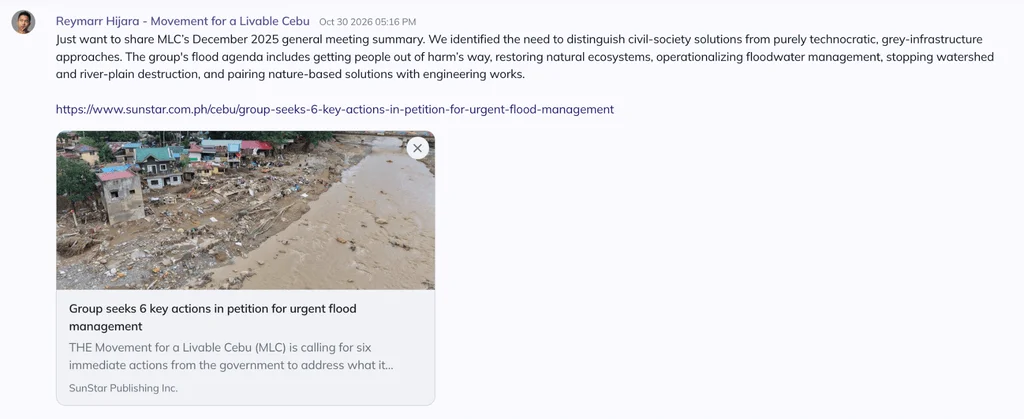
Reymarr Hijara of the Movement for a Livable Cebu (MLC), a civic group advocating safer and more sustainable flood management, said the group’s six proposed actions remained largely unfinished or unverified a year after Tino. The proposals included creating a Cebu Floodwater Management Office, moving families out of high-risk areas, protecting watersheds, reviewing flood-control structures and establishing no-build zones in places inundated during the storm.
MLC proposed the measures in a petition for urgent flood-management action in November 2025. The most concrete development Hijara cited was the group’s invitation to join the Provincial Flood Control and Drainage Task Force, formed under Executive Order 74 after the November 2025 flooding. He stressed that a seat on the task force does not show that the proposed measures have been put into practice.
“A task force is not yet implementation,” Hijara said in the chat room. The distinction matters: setting up a body creates a place to discuss the problem, while residents need to see whether decisions lead to safer housing and lower flood exposure.
The anniversary also prompted two public activities: a guided walk through downtown Cebu focused on urban vulnerability, and a multi-stakeholder dialogue on flood-control accountability and the continuing needs of survivors.
A city walk connects memory with adaptation
The University of the Philippines Cebu’s College of Communication, Art, and Design organized the walk with participants from the University of the Philippines Open University and Japan’s Meiji University. The route passed through San Nicolas, Pasil, Taboan, Carbon Market, Plaza Independencia and Colon, drawing attention to the city’s built environment, public spaces, transport systems and cultural heritage.
Dean Crina Tanongon of UP Cebu’s CCAD said Tino’s severe flooding gave participants a reason to consider how Cebu can respond to flooding and extreme heat while retaining its cultural identity. The walk also invited comparisons between climate adaptation approaches in the Philippines and Japan, and discussion of lessons that could help make Cebu’s communities safer and more livable.
“We chose a guided walk because remembering is not merely a cognitive exercise. It is sensory and embodied,” Tanongon said. The format put the anniversary’s reflections in the streets and public spaces where questions about urban design, movement and exposure to hazards are experienced directly.
Dialogue turns to relocation and public spending
Sugbuanong Pakigbisog Kontra Kurapsyon (SuPaKK) and partner organizations convened a separate discussion under the title “Kahinumdom pa mo namo? (Do you still remember us?) A Multi-Stakeholder Dialogue on Flood Control Accountability and the Continuing Concerns on Typhoon Tino Survivors.”
John Roy Rigodon of the Sectoral Transparency Alliance on Natural Resource Governance (STANCe) reported on visits to flood-prone communities along Cebu’s major rivers, including the Kinalawan River in Toledo City and the Cotcot River in Liloan and Compostela. Residents he encountered remained concerned about their safety when typhoons arrive, as well as the lack of secure, permanent relocation options.
“Will they be safe in the next typhoon?” Rigodon asked, pointing to relocation as a major concern. The question links housing decisions to disaster preparedness: for families in exposed locations, a future storm is not an abstract planning scenario.
Participants also questioned flood-control spending. Organizers cited P17.4 billion for major river flood-control projects between 2016 and 2025, including P11.1 billion for the Butuanon River, and called for greater transparency and accountability. The figures were also reported in a SunStar Cebu investigation examining how Tino’s floods exposed failures in Cebu flood-control projects.
Norika Ishikawa of the Cebu Anti-Corruption Coalition and Center for Emergency Aid, Rehabilitation and Development Inc. (CONCERN) raised concerns about how rehabilitation would be funded amid reported cuts to disaster rehabilitation and housing funds for 2027. She argued that recovery must address daily needs as well as housing: safe and affordable homes, access to livelihoods, utilities, roads, hospitals and schools.
“Disaster rehabilitation is not an expense. Building back better is a public investment,” Ishikawa said. She identified developing a relocation agenda with informal settler families affected by Tino and mobilizing for an accountability action on November 30 as next steps from the dialogue.
“Nakakalungkot ang sharing, nakakagalit ang inaction, but hopeful pa rin” (The sharing is saddening, the inaction is infuriating, but there is still hope), she said.
The scale of recovery still ahead
Tino affected nearly 2 million people in Cebu and displaced more than 636,000. The storm caused 96 confirmed deaths, with many people still missing, and damaged about 262,000 homes, including more than 24,000 that were totally destroyed. Those figures help explain why a year’s passage has not settled the questions raised by residents: the scale of loss is matched by continuing concerns about shelter, flood exposure and recovery.
The anniversary’s discussions brought those needs into the same frame as flood-control accountability. Residents described what recurring floods mean at street level; civic groups pointed to unfinished proposals and questions about spending; and organizers outlined steps around relocation and public scrutiny. The measure of progress, their accounts suggest, will be whether families can reach safety and rebuild lives with the services they need before the next severe rain tests Cebu again. – Rappler.com


