The 2026 Fields Medal, one of the top honors in mathematics, has been awarded to four distinguished researchers, including Hong Wang, making her the third woman to receive this accolade in its 90-year history. The Fields Medal is presented quadrennially to mathematicians under 40 for exceptional work, and Wang, a professor at New York University, has been recognized for her contributions to a longstanding problem regarding the movement of needles in three-dimensional space.
The Significance of the Fields Medal
The Fields Medal is not just a prestigious title; it represents the pinnacle of achievement in mathematical research. Awarded every four years, this accolade has a long history of recognizing groundbreaking insights and contributions that have shaped modern mathematics. One might consider how this recognition can influence a mathematician's career trajectory — not just in terms of enhanced credibility but also for future funding opportunities, academic positions, and collaborations. Many past recipients have gone on to become leaders in their fields, impacting educational programs and research directions globally.
Wang's Landmark Achievement
Wang’s recognition stems from her groundbreaking work on the Kakeya conjecture, a problem that has baffled mathematicians for decades. This conjecture seeks to answer a seemingly simple question: What is the least area required for a needle of varying angles to pivot fully in three-dimensional space? This elegant inquiry has implications far beyond academic curiosity; it touches upon concepts in physics, engineering, and even computer science. A resolution to this problem not only enriches theoretical mathematics but also informs practical applications in various high-tech fields.
Collaborating with Joshua Zahl, Wang drew upon her expertise in harmonic analysis, a branch of mathematics that explores signal deconstruction. Their work illuminated a precise relationship between the directional thickness of 'tubes' tracking the needle and the total space they occupy. This careful examination and verification of complex mathematical relationships is part of what makes Wang’s achievement noteworthy. The intricacy of her proof, spanning 127 pages, shows a level of dedication and intellectual rigor that is extraordinary.
A Formidable Educational Journey
Hong Wang’s journey to this accolade wasn't without its obstacles. Those closely following her work might recall that she experienced uncertainty about her proof initially. After spending months scrutinizing the details, their findings garnered widespread acclaim as a "---once-in-a-century---" result, akin to proving a long-confounded theorem or offering solutions to pressing mathematical questions. In examining the landscape of educational inequities, Wang's triumph also shines a light on the need for support and resources aimed at nurturing mathematical talent from diverse backgrounds. Without adequate mentorship and encouragement, who knows how many other bright minds might never realize their potential?
Recognition and Equality in Mathematics
Wang joins a select group of female Fields Medal recipients, adding her name to the ranks of Maryam Mirzakhani, who won in 2014, and Maryna Viazovska, who was honored in 2022. This signals a slow but important shift towards greater gender inclusivity in the field of mathematics. Historically, female mathematicians have had to work tirelessly to gain recognition in a discipline that has often marginalized their contributions. What this means for young women pursuing careers in math and science can't be understated; representation matters.
Implications and Future Outlook
The announcement of the 2026 Fields Medalists during the International Congress of Mathematicians in Philadelphia underscores a celebratory moment not just for the winners, but also for the mathematical community at large. The event signifies the ongoing evolution of thought within mathematics and reiterates the importance of recognizing diverse talent. With only 65 men having received the medal, the underrepresentation of women and minority groups remains an issue that deserves attention. This is less of a mark against the mathematical community than a reflection of societal disparities that persist in academia.
As Wang steps onto the global stage, the implications of her achievement extend beyond personal accolades; they inspire a new generation of thinkers. If you're working in this space, consider how her success could spark new initiatives focusing on inclusivity, interdisciplinary collaboration, and appreciation for diverse approaches to complex problems. The field must continue to embrace varied perspectives that can lead to breakthroughs — who knows what other masterpieces could emerge if fresh minds are given the chance to explore? The excitement around her recognition reveals more than an award—it raises essential questions about equity, access to opportunity, and the future shape of mathematical inquiry.
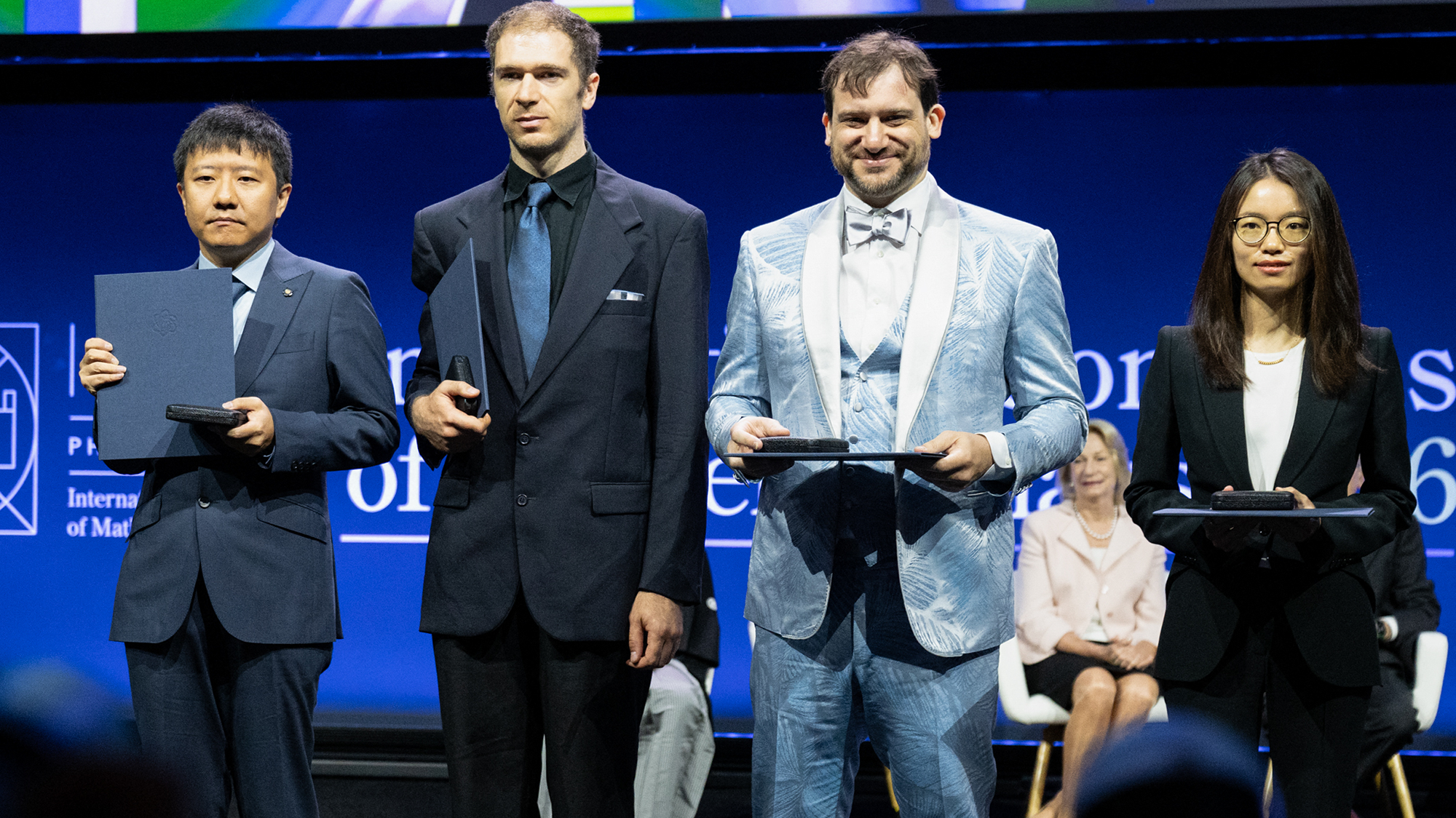
Wang was celebrated for her resolution of the Kakeya conjecture. This complex problem revolves around determining the minimal amount of space required for a needle to pivot in every direction within three dimensions—a challenge that has perplexed mathematicians for over half a century.
The medals were presented during the International Congress of Mathematicians held in Philadelphia, marking another milestone since the first awards were given in 1936. To date, only 65 men have received this prestigious honor.